Home · Roof Ventilation & Attic
Roof Ventilation & Attic · Ogden & Northern Utah
Ice dams in January, a hot upstairs in July, shingles aging before their time. A lot of roof problems start with an attic that can't breathe. We measure what your attic actually has, tell you what it needs, and rebuild the airflow, intake and exhaust both.
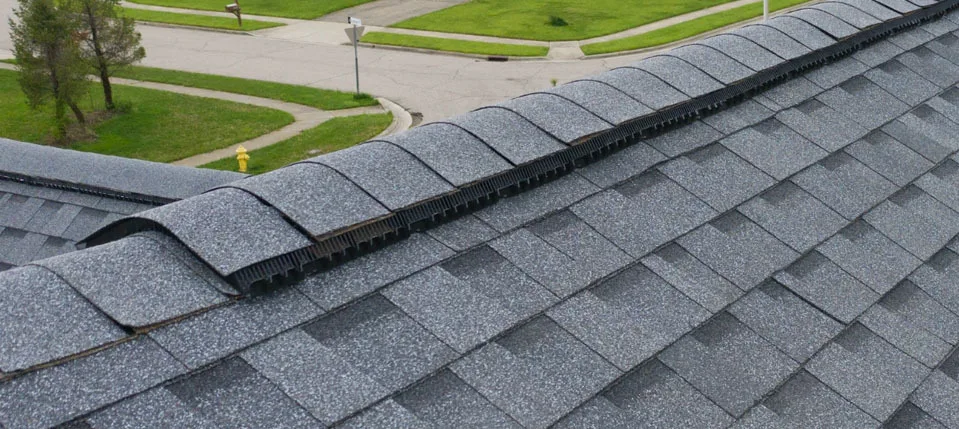
Roof ventilation is a continuous air path through your attic: cool outside air comes in low at the soffits, washes the underside of the roof deck, and exits high at the ridge. When that flow is balanced, your attic runs cooler in summer, drier in winter, and your shingles age the way the manufacturer intended. When it isn't, you see the results as ice dams, a hot second floor, frost in the attic, and shingles that curl early.
It's also not guesswork. Building code puts numbers on it. An attic needs about 1 square foot of open vent area for every 150 square feet of attic floor. With a balanced system that puts 40–50% of the venting up near the ridge, code allows 1 per 300. Many older homes along the Wasatch Front fall short, usually because the soffit intakes were blocked by insulation years ago and nobody ever checked.
The air path
Both halves have to be open. Intake without exhaust, or exhaust without intake, and the air stops moving.
Your roof may not have a ridge vent, and that's fine. Plenty of homes here exhaust through box vents, turbines, or gable vents instead. The principle doesn't change, only the arithmetic: air still has to come in low and leave high. What does matter is not running two kinds of exhaust at once, and that's the section just below.
The most common problem we find is ventilation out of balance: exhaust up top with too little intake feeding it. Sometimes the intake was never there, and sometimes insulation got stuffed into the soffits and blocked it. Either way the exhaust has nothing to pull, and the whole system stalls. Baffles keep that channel open, and they cost very little compared to the shingles they save.
The symptoms
A warm attic melts the snow above it, and the melt refreezes at the cold eaves. Ventilation helps flush that heat, though it's one piece of the fix, not the whole story.
On a 95° day an under-vented attic can sit at 120–140°F, and that heat radiates down into your bedrooms all evening long.
In January, humid indoor air leaking into a cold attic freezes on the sheathing and nail points. When it melts, it looks exactly like a roof leak.
Heat from below cooks shingles and shortens their life, and shingle manufacturers exclude damage from inadequate ventilation from their warranties.
The insulation is acting like a furnace filter. Air is being pulled through it because the intake is blocked, and the dirty streaks near the roof edge are the dust it caught.
Code says exhaust fans must vent outdoors, never into the attic. A fan dumping shower steam up there is a moisture problem waiting for winter.
How we size it
Every vent has a rated open area published for it: a foot of ridge vent flows about 18 square inches, a standard box vent about 50. An assessment means measuring your attic, adding up what's really there, and comparing it to what code requires. A typical 1,500-square-foot attic with a balanced system needs around 5 square feet of open vent area. Without that balance, code asks for double. That's roughly 20 feet of ridge vent up top, matched by at least as much intake down at the soffits.
Two rules matter as much as the totals: intake should equal or beat exhaust, and you don't mix exhaust types. A ridge vent paired with old box vents short-circuits. The vents start feeding each other instead of pulling air from the soffits, and the attic barely moves air at all.
The service
The cheapest time to fix ventilation is during a roof replacement, when the decking is already open. Every replacement we quote includes the ventilation math. But most of this work can be done on your existing roof, too.
Ice dams and attic frost are caused mostly by warm house air leaking into the attic and by thin insulation. Fix those first, or the venting is fighting a problem it can't solve. Air sealing and insulation are an insulation contractor's trade, not ours. If that's your real problem, we'll show you the photos, say so plainly, and fix the roof side while you get the right trade on the rest.
GAF's warranty doesn't cover damage caused by inadequate ventilation, and Owens Corning's extended warranties require an attic ventilated to code in the first place. That's the quiet reason ventilation belongs in every replacement quote: we size it to code so the manufacturer never has a reason to question the standard warranty on your new shingles. That's their warranty on the materials. Our own 10-year workmanship warranty on full replacements is a separate promise.
How our warranty works →The last layer
Even a well-sealed, well-vented roof can have stubborn spots. Shaded north eaves, short overhangs above unheated garages, tight valleys. That's where heat cable earns its keep: it keeps melt channels open where the sun and the attic fixes can't reach.
Ventilation FAQ
The code baseline is 1 square foot of open vent area per 150 square feet of attic, or 1 per 300 with a balanced system that puts 40 to 50 percent of the venting near the ridge. For a typical 1,500-square-foot attic with a balanced system, that's about 5 square feet of real, unblocked vent area, and double that without the balance. We do that math during the free inspection and show you where your attic lands.
It helps, but it's usually not the whole fix. Ice dams come first from warm air leaking into the attic and from thin insulation; ventilation flushes out what's left. If we look in your attic and the real problem is air leaks or insulation, we'll tell you that instead of selling you vents. That work belongs to an insulation contractor, and doing it first makes the ventilation actually work.
Yes. GAF's warranty language excludes damage caused by inadequate ventilation, and Owens Corning requires code-level ventilation to qualify for its extended system warranties at all. A roof installed over a starved attic can lose warranty coverage before it loses a single shingle.
Usually, yes. Ridge vents can be cut into an existing roof, soffit vents can be opened or added, and baffles (the chutes that keep insulation from choking the vents) can be set from an accessible attic. It's simply cheapest during a replacement, when the roof is already open, which is why our replacement quotes include it.
Our default advice is balanced passive venting first. A powered fan can pull air-conditioned air out of the house through ceiling gaps, which costs you money to solve a problem that soffit and ridge vents handle without a motor. There are cases for fans, but they're the exception, and we'll say so if yours is one.
Less than in wetter states, and that's worth saying plainly. Winter moisture in a Northern Utah attic usually has a specific cause: a bath fan venting into the attic, a humidifier running high, or big air leaks around lights and hatches. Those are findable and fixable, and they're exactly what we look for.
Free inspection
Tell us a little about your roof and we'll get right back to you. Prefer to talk now?
Calls returned within the hour · Mon–Sat
952 28th St, Suite D · Ogden, UT 84403
Serving Ogden & Northern Utah · Locally owned & operated
Your free inspection includes the ventilation math: measurements, photos, and a straight answer.