The clearest signs are granules filling your gutters, shingles cracked or curled or missing across whole slopes, daylight or spreading water stains in the attic, a sagging ridge line, and repairs that keep coming back in new places. One symptom on a young roof is usually a repair. Several at once on an older roof is a replacement.
Written by Cameron Husom, owner of Compass Roofing in Ogden. Last updated July 2026.
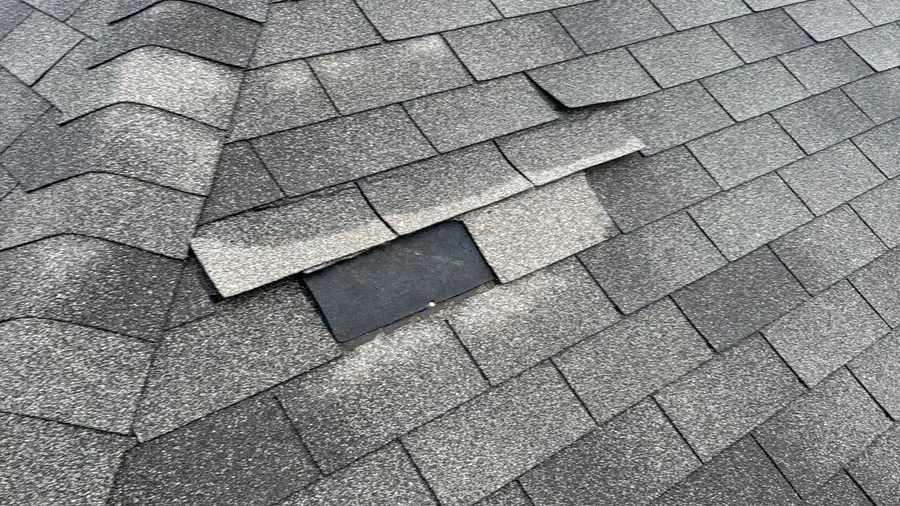
More than you would think. Grab binoculars, walk to the far side of the street, and look at four things.
The ridge line. It should be dead straight. A dip, a sag, or a wave in a roof plane points at something structural underneath, either decking that has gone soft or a framing problem. This one matters more than anything else on the list, because shingles cannot fix what is under them.
Missing, lifted, or crooked shingles. Gaps that show a different color underneath mean the underlayment is doing a job it was never meant to do alone. Look along the edges and ridges first, since that is where wind gets underneath.
Dark or patchy areas. Uneven color across a slope often means the granules have worn thin in places. On an older roof that is the surface giving up unevenly.
The pipes and chimneys. Look at the metal around anything poking through the roof. Rust, gaps, or sealant that has visibly cracked away is worth noting, though this one is usually good news, since flashing problems are repairs rather than replacements.
Gutters are the most honest thing about an asphalt roof, and you can check them from a stepladder at the downspout without going anywhere near the roof.
Asphalt shingles are protected by a layer of ceramic granules. Those granules are the shingle’s sunscreen, and once enough of them are gone the asphalt underneath starts to harden and crack.
A little is normal. A newly installed roof sheds loose granules for the first few months. A handful in the gutter after an install is expected.
Steady accumulation is not. If you are cleaning out what looks like coarse black sand every time, and the roof is not new, the surface is wearing through. Check the bottom of the downspouts, which is where it piles up.
After a hailstorm, look specifically. Hail knocks granules loose in concentrated spots. A sudden pile after a storm is a reason to have the roof documented with photos, whether or not you end up filing anything. Our guide on whether insurance covers a new roof walks through what happens from there.
The attic tells you the truth earlier than the ceiling does, because by the time a stain shows up in a bedroom the water has usually been in the decking for a while. Take a flashlight up after a rainstorm and look for four things.
Daylight through the boards. Pinpoints of light where there should be none.
Dark tracks running down the rafters. Water runs along framing before it drips, so the stain you find inside is often uphill of where the water is actually getting in.
Damp or matted insulation. Insulation that has been wet and dried repeatedly goes flat and stops working.
Rusty nail points, or frost on them in winter. That usually means warm house air is leaking up into the attic and condensing there, rather than water getting in through the roof. The fix is air sealing and insulation first, then ventilation. Different problem, and a much cheaper one.
Wind is the one that catches Northern Utah homeowners out, because the damage often does not look like damage.
A creased shingle is a broken shingle, even if it lies back down flat. Wind lifts a tab, bends it at the nail line, and the wind lays it back down when it passes. The crease has already broken the mat and the seal, and that shingle will fail early even though the roof looks untouched from the driveway.
Worth knowing locally: the damaging winds here are easterly downslope events that gust out of the canyon mouths toward the valley, so it is often the east-facing planes that take the worst of a wind event rather than the west. If you are only going to look at one side of the house after a big blow, look at the side facing the mountains.
This list matters as much as the other one, because these are what get homeowners talked into a roof they did not need.
| What you see | What it usually is | Repair or replace |
|---|---|---|
| Black streaks down the slopes | Algae staining, cosmetic | Neither, it is a cleaning question |
| A few missing tabs after one storm | Localized wind damage | Repair |
| A leak around a chimney or vent | Flashing or sealant | Repair, and often a small one |
| One ceiling stain from one source | A single point of entry | Repair |
| Big icicles and ice at the eaves | Attic heat and airflow | An insulation and venting fix, not a roof |
| Granules shedding on a new roof | Normal break-in | Neither |
Flashing deserves a specific warning. Leaks around chimneys, vents, and skylights are the most common leaks on any roof, and they are also the most over-sold. If someone quotes you a full replacement for a flashing leak and cannot walk you through why the rest of the roof needs to come off, get another opinion before you sign.
There is no magic number, but the pattern is consistent.
One sign, in one place, on a roof under fifteen: almost always a repair. A roof that is otherwise sound with a single problem is a roof worth fixing.
Several signs at once, or the same sign in new places: the roof is failing as a system. Three repairs in three different spots is not three problems, it is one problem showing up three times.
Anything structural, at any age: get eyes on it. Sagging and soft decking do not resolve on their own and they get more expensive every season.
Age is the multiplier on all of it. A single lifted shingle means something very different on a six-year-old roof than on a twenty-two-year-old one, which is why how long a roof actually lasts is worth reading alongside this. And once you know you have a problem, the next question is whether to patch it or replace it, which is exactly what our repair versus replacement guide works through.
If you would rather just have someone look, that is what a free inspection is for. We get on the roof, photograph what we find, and tell you which of these you actually have. Sometimes the answer is that you have years left, and that is a perfectly good outcome for everyone.
Common questions
Please don't climb up. Falls from ladders are the way homeowners get badly hurt doing this, and a roof that is already damaged is exactly the roof most likely to give underfoot. Everything in this guide can be checked from the ground with binoculars, from inside the gutters, or from the attic with a flashlight. If those turn up something, that is the point to have someone who does it for a living get on the roof with proper footing.
Once a year is plenty for most roofs, plus a look after any windstorm or hailstorm that made you notice it. Spring is the natural time here, because it catches whatever winter did before the summer sun bakes it in. Past fifteen, or on a roof that has already needed a repair or two, adding a second look in the fall is worth the small effort. Not because of the birthday, but because a leak that sits through a whole winter is how a shingle problem becomes a decking problem.
Not necessarily, though it is worth a look. Storms are surprisingly local, and hail especially can work one street hard and leave the next one alone. Roof age matters too: the same storm can total a fifteen-year-old roof and barely mark a five-year-old one. What it does mean is that a storm came through close enough to check, and that door-knockers will be in your neighborhood for a while. Get your own roof looked at on its own merits before signing anything with anyone.
Usually not. The black streaking most people notice is algae, and it is a cosmetic stain rather than damage. Moss is more of a real issue because it holds moisture against the shingle and can lift edges over time, but on a sound roof it is a cleaning-and-trimming job, not a replacement. It grows on the shaded, north-facing planes and under overhanging branches, so cutting back what is shading the roof usually does more good than anything else.
It depends entirely on which problem. Cosmetic things like algae can wait indefinitely. A few lifted tabs can usually wait for decent weather. Anything letting water in should not wait, because the expensive part of a roof problem is almost never the shingle, it is the decking and framing underneath once water has been sitting on them. The honest answer for most people is that getting it looked at is urgent, and the repair itself often isn't.
More guides
When homeowners insurance pays for a roof replacement in Utah, how ACV and RCV policies differ, why your roof's age changes the payout, and what you always owe.
How long a roof lasts in Northern Utah by material, why our freeze-thaw winters and canyon wind shorten it, and the signs that yours is near the end.
When a roof repair is the right call and when it's throwing money at an old roof: how age, extent, and repeat repairs decide it, with real Northern Utah costs.
Free inspection
Tell us a little about your roof and we'll get right back to you. Prefer to talk now?
Calls returned within the hour · Mon–Sat
952 28th St, Suite D · Ogden, UT 84403
Serving Ogden & Northern Utah · Locally owned & operated
Free inspection, photos of what we find, and no pressure.